

An Eggplant Horse for Milky: Obon, Memory and the Quiet Ways We Stay Connected
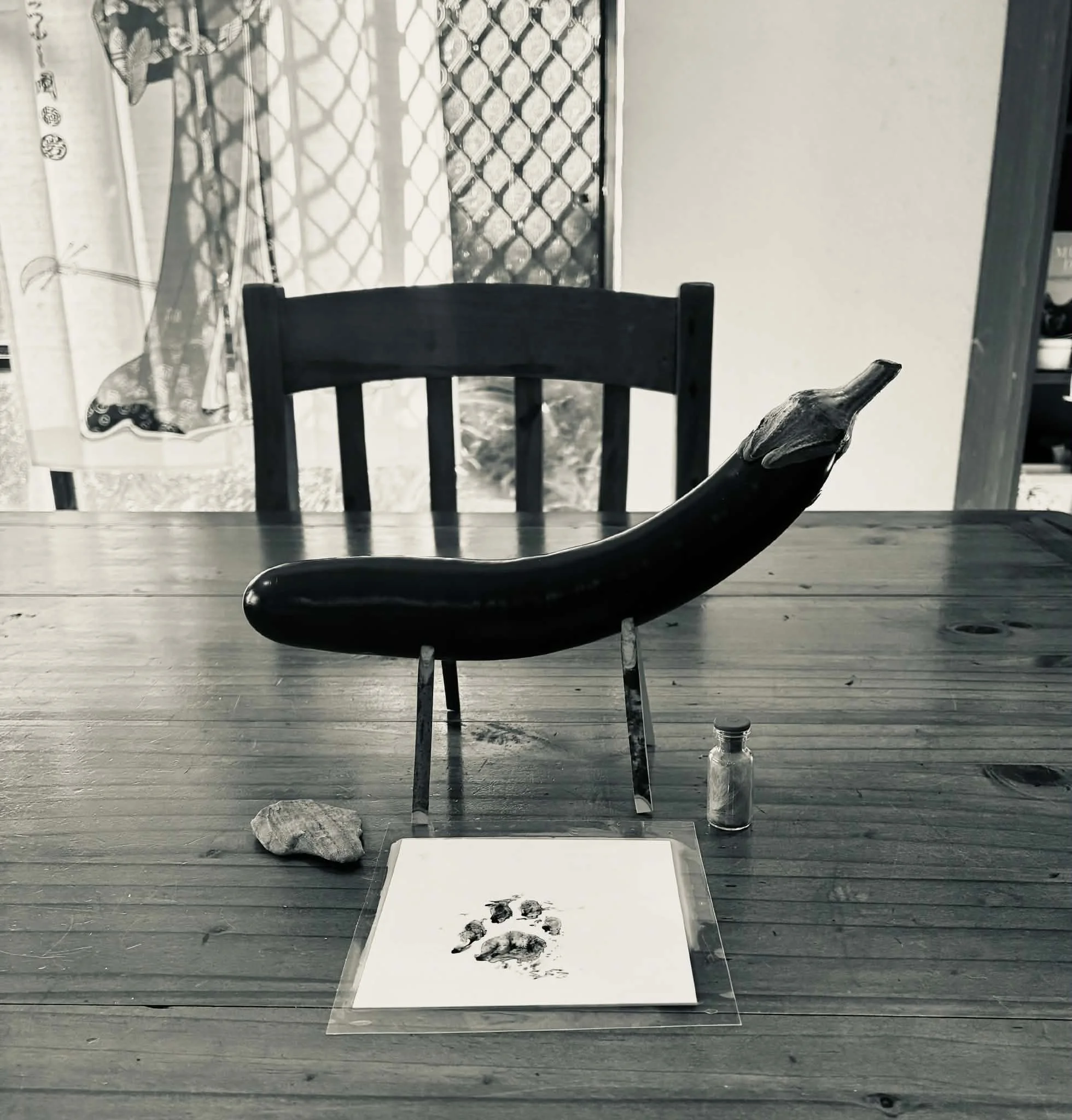
A few days before Obon this year, I went to a local market here in Far North Queensland and bought an eggplant.
But this particular eggplant wasn't for dinner.
I was going to turn it into a little horse for Milky Boy.
Milky was my beloved cat, my best friend and very much part of our family. He passed away on 15 August 2023, a date that happens to fall right in the middle of Obon, the Japanese tradition of remembering and welcoming back the spirits of loved ones who have died.
Although I have lived in Australia for many years, this year I felt drawn to honour Obon a little more intentionally.
And so, before Obon began, I sat down with my eggplant and some wooden sticks and made Milky a horse.
It was such a simple thing.
An eggplant. Four little legs.
Yet somehow, it meant so much more.
A little horse to come home
In Japan, Obon is commonly observed around 13–16 August. Customs vary between families and regions, but at its heart is remembrance and connection with those who came before us.
One tradition is to make shōryō-uma from vegetables.
A cucumber is traditionally made into a horse, representing a wish for our loved ones' spirits to return quickly, while an eggplant becomes an ox, representing a slower journey back after spending time with us.
This year, however, my eggplant became Milky's little horse.
I wasn't trying to recreate every detail of Obon perfectly.
I simply wanted to create something for him.
During Obon, I placed it in the little space I had prepared for Milky, together with his photograph, his ashes, some of the fur I kept when he passed away and the beautiful ink paw print made for us by the veterinary clinic.
Looking at this little space, I felt connected to him again.
His body is no longer here.
But the relationship, the memories and the love haven't simply disappeared.
Perhaps rituals give us somewhere to place that love.
Rediscovering culture from far away
Living outside Japan for so many years has changed the way I experience my own culture.
When we grow up surrounded by traditions, sometimes we simply do them because that's what our families or communities have always done.
But distance can create curiosity.
And perhaps getting older does too.
I find myself asking more often:
Why did people do this?
What meaning sits underneath this tradition?
What were our ancestors trying to preserve or pass on?
I don't think reconnecting with culture means we have to practise everything exactly as it was once practised.
For me, it is more about becoming curious about its meaning and finding what still speaks to us now.
Making that little eggplant horse in my Australian home was one of those moments.
It connected me with Milky, but it also connected me with Japan and with another part of myself.
When memory brings us back to the present
Something else happened while I was remembering Milky.
I became more aware of what — and who — is in my life now.
After Milky passed away, two more animals became part of our family: Princess, our cat, and Sachi, our dog.
They bring so much joy and fulfilment into our lives.
Of course, living with animals isn't happiness every minute of every day.
There are illnesses to worry about, messes to clean, responsibilities and plenty of little challenges.
But that is part of the package of loving another living being.
Sometimes Princess or Sachi will do something that suddenly reminds me of Milky.
Recently, we discovered that Sachi loves pawpaw.
I immediately said to my partner,
"Look! He's like Milky Boy. Milky loved pawpaw too."
Such a tiny thing.
But for a moment, Milky was right there in the conversation again.
Sachi doesn't replace Milky. Neither does Princess.
They have their own personalities, their own place in our family and their own relationships with us.
But remembering Milky sometimes makes me appreciate their presence even more.
Perhaps remembering what we have lost can also remind us to notice what we still have.
Grief and gratitude don't always have to live separately.
What does this have to do with IKIGAI?
IKIGAI is often presented as finding one big purpose in life.
But the more I explore the original Japanese ideas around IKIGAI, and the more I experience my own midlife, the less I feel it needs to be something grand.
IKIGAI can live in much smaller places.
The people and animals we love.
The memories we carry.
A connection with our culture.
A sense of belonging.
The small moments that make us feel quietly glad to be alive.
Perhaps rituals such as Obon simply create a little space for us to notice these things again.
And you certainly don't need to be Japanese or practise Obon to experience this.
Cultures around the world have their own rituals for remembering loved ones, acknowledging change, honouring ancestors or marking the seasons and stages of life.
Rather than seeing these traditions simply as things people used to do, perhaps we can become curious about them.
Why did this ritual matter?
What human need was underneath it?
And is there something within it that still has meaning for me today?
Culture can be a form of self-care
At this stage of my life, reconnecting with parts of my Japanese culture has begun to feel like another form of self-care.
Not self-care as an escape from everyday life.
Something quieter.
Honouring where I came from.
Giving myself permission to remember.
Being curious about parts of myself that perhaps I didn't appreciate in quite the same way when I was younger.
And allowing old traditions to take on new meaning in the life I live now.
Making Milky's little Obon space gave me somewhere to express love for someone who is no longer physically here.
Yet strangely, looking backwards also brought me back into the present.
To Princess.
To Sachi.
To my partner.
To our home.
To the life that has continued to grow around the space Milky left behind.
Maybe that is one of the quiet gifts of remembrance.
Our lives are made from so many relationships, experiences, places and living beings who walk beside us for different lengths of time.
Some remain.
Some leave.
And some become part of the stories we continue to carry.
Perhaps our IKIGAI is shaped by all of them.
This year, my little eggplant horse was for Milky Boy.
Made in Far North Queensland, many kilometres away from Japan.
A small bridge between two countries.
Between an old tradition and my life now.
Between memory and the present.
And a gentle reminder to appreciate the lives beside me today.